Fullstack Developer / AI Consultant
Fredrik Bränström
Your friendly neighbourhood polymath problem-solver. Senior AI-orchestration architect and full-stack engineer.
Industry experience
-
Early developer of B2B order and e-prescription systems for one of Sweden's leading pharmacy startups ApoEx, fueling rapid expansion and eventual market dominance in the B2B healthcare sector
-
Co-founded a health analytics startup, leveraging cutting-edge statistical theory and wearable tech to uncover and visualize causal relationships in health data
-
Built backend for social features of the fintech startup Dreams iOS app, integrating psychology and AI to help users save money effectively
-
Engineered a client application for Tobii's innovative eye-tracking analytics, transforming attention market share measurement for top industry brands
Enhanced and expanded Lloyds Pharmacy's e-commerce platform

“This guy is a rock-solid developer packed with helpful thoughts and a rich experience across the web
stack. Constantly evolving and eager to learn, Fredrik makes a great contribution to both technology
and the business by challenging himself and not holding back at the edge of his comfort zone.”
– Didde Brockman, Chief Product and Technology Officer, Dreams Nordic
Skills and values
I love being part of a vibrant team taking on technically and conceptually interesting challenges, striving to make humanity better able to handle complexity or otherwise have as massive an impact on the world as possible. Co-founded Kaus, a startup focused on life/health data analyses using new methods in statistics/machine learning. Burnout woke me up to needing more balance in life. Now selectively freelancing, with a deliberate eye on workload and meaning. I'm an experienced full-stack developer (Ruby on Rails, JavaScript and TypeScript, React, Vue, Node.js, Python, Rust), with respect and an eye for user experience, design, psychology, business, strategy, knowledge management and other aspects of building a service or a movement, while a believer in the primacy of the gear shifts that technology enables.
Working with people
I can teach, engage and lead people in projects, love to learn, and possess a large, open network of deeply knowledgeable friends and acquaintances spanning different entrepreneurial areas and academic fields.
What I'm drawn to
What I keep coming back to is a generalist's instinct: that the interesting problems are where psychology, technology, complexity-thinking and art meet. I read across disciplines and try to weave the angles rather than choose between them. I think a lot about AI ethics, about how technology can benefit all of humanity rather than only those who already have most, and about how the systems we build shape the way people think, decide and live alongside each other.
The longer thread
Underneath all this is something close to: how do we help groups, and eventually whole societies, reason and feel together more clearly? Trust and cooperation seem to scale with the quality of the shared infrastructure underneath them, the spaces where reasoning, attention and care can actually meet. Most of what I build is part of that in one way or another.
AI
I have a strong interest in AI and how it relates to human psychology, rationality and emotions. The potential of AI and automation is great, as is the need to make sober decisions on how it can optimally benefit all of humanity. I have dedicated significant time to understanding and discussing its implications, ethical and practical.
In practice
In the last few years that interest has turned into practice. I've built several AI systems that are in use: one with paying customers, a public platform for deliberation, and a voice assistant I use every day, with screen vision and a knowledge graph as memory. I've also contributed reliability fixes to the open-source memory layer they depend on, and I run some models on my own machines to keep cost and latency down.How I work with AI agents →How I actually work with coding agents day to day, and how that grew out of Aider, Cursor and Claude Code since July 2023, is on its own page.
Direction
These days I'm most interested in AI that helps people pay attention and judge for themselves: voice assistants that stay quiet unless something matters, automation that only acts once it has proven itself, and tools for deliberation that make it clearer what people actually think.
Portfolio
Ambient AI in daily life
Ruby, a personal voice assistant with screen vision, knowledge-graph memory, and echo cancellation that lets me interrupt her, layered over a contextual narration system that turns my coding work into selective ambient audio.Cohabit, a household-automation dashboard for the shared house I live in. Rent calculation across roommates with auto-fetched electricity bills and Swish payment reconciliation, BankID-signed digital contracts, heat-pump scheduling tied to live electricity prices, and an admin UI that makes the whole household ledger inspectable. Plus presence-aware lighting and an at-a-glance view of transit departures, the shared calendar, gardening chores and (WIP) greenhouse automation.Fyr (Swedish for lighthouse), a personal cross-platform desktop AI assistant I'm building first for myself, then for friends and family. Two brains share one knowledge-graph memory: a slow, deep one for chat and long-horizon work, and a fast, voice-shaped one for quick replies, so the assistant stays coherent whether I type or speak. A heartbeat engine continually scans my tasks, bills, project todos and notes, and surfaces what matters most next rather than burying me in a dashboard. Those todos pull in from multiple sources (TickTick, plain TODO.md files, Workflowy) and live in one kanban backed by the same memory graph.
In production with users
An AI document-processing platform I designed and built for a paying operator: it turns dense PDFs into structured records and drives the downstream submission end-to-end, at LLM costs measured in fractions of a krona per document. The architecture is the interesting part. The pipeline carries its own local simulator of how the target system behaves, observes the real-world acceptance signal, and closes the residual gap analytically rather than guessing. A small example of what becomes possible when you stop trying to predict a complicated system and let it tell you what it thinks instead. It's also where I've learned the most about production LLM integration, the gap between a demo and a system you can leave running overnight.ArtoMatic, a print-on-demand art automation pipeline for the artist Sam Rosen: around 1,040 artworks ingested from Drive, vision-based AI title generation in six literary styles, parallel processing with thread-safe error recovery, and full Shopify integration.A personalised Claude Code and Revit-automation environment for a structural engineer in my family: 14 task-specific skills auto-activating on his natural Swedish prompts, a first-party native Revit add-in spanning material take-offs, grid naming, QA/QC and structured export, and a git-pull deploy pipeline that propagates updates straight to his desk. One day from analysing his chat transcripts to live use on real client work.Din Mamma / Debt Intelligence Module / DIM, a Swedish-locale guardian for the everyday obligations that quietly stack up (bills, reminders, inkasso), built around a positive aim: enough calm and clarity that they get handled before they become shame, fees or crisis. It fuses Kivra and bank-feed data into one trusted picture and follows the full lifecycle of an obligation across senders (invoice, reminder, inkasso, Kronofogden). Currently in early use with family, and a few close friends are about to start testing alongside Fyr; DIM is likely to slot into Fyr eventually as its financial-obligations module.
Open source & AI native
nit and hemma are a pair of small tools for keeping a group of computers configured the way you want them, without having to redo the setup on each one by hand.nit looks after a single machine. It keeps a versioned history of all your preference files, encrypts the secret ones (API keys, passwords) so they can travel safely between your computers, and runs small maintenance scripts whenever a setting changes. It's built for the world where several AI agents work in parallel. Each one might be editing your settings at the same time, so any change one of them makes is shown clearly before another can overwrite it.hemma stretches the same idea across many machines. It can take a fresh computer (a laptop, a server, or a tiny Raspberry Pi) from blank to fully-configured with a single command, keep your machines in sync with each other, and even prepare a Raspberry Pi's SD card so the new machine joins the rest the moment it powers on.They work together but don't have to: nit is happy alone on a single machine, and hemma works just as well with other configuration tools. Together they replaced an older tool called chezmoi across my own four-machine setup.karabiner-mods turns Caps Lock into a dual-purpose key: tap for Escape, hold for 40 one-key shortcuts that send prompts and commands to AI agents. Each shortcut does one thing, and longer moves, like wrapping up a session, are chains of them. There's also an Xbox Wireless Controller layer (25 actions via standalone buttons and LB/RB combos), mouse-button shortcuts, and SuperWhisper voice-dictation integration. Karabiner-Elements is someone else's software; what I've published is the set of shortcuts and the thinking behind them.Contributions: a fork of graphiti-core (knowledge-graph memory for AI agents). The main work is project isolation: making it safe to run a single shared memory server across multiple AI projects, with each project's agents seeing and writing only their own data and no cross-leakage. Two new tools sit alongside: one for fast structured writes when an agent already knows the shape of the data (skipping the slower natural-language extraction path), and one for re-importing the same data from external sources without creating duplicates. And an upstream patch in anyio that fixed a 37% idle-CPU spin in any persistent-async workload.Other open-source work: spela (single-binary torrent-to-Chromecast media controller replacing a six-app stack), Lins (graph explorer for FalkorDB filling a real ecosystem gap), project-launcher, system-sentinel, claude-shim-pipeline.Industry experience →For pre-2020 corporate roles (ApoEx, Lloyds Pharmacy, Dreams, Tobii, Hemnet, Kaus), see the dedicated section.
Vibe Science
A creative side-thread running underneath everything else. Understanding someone is partly reasoning
and partly a felt encounter, a deliberate attunement and curiosity which transcends the intellect, and
that second half has always fascinated me: what makes a room open people up, and how light, sound and
ritual help facilitate a shared field of resonating energy. Vibe Science is my name for the vision that
we might one day understand atmosphere between people more deeply than we do now, and that the small
inputs that shape it might become a little less mysterious. Two ongoing prototypes for Borderland (the
Swedish regional burn), one already up and running and one still on paper, are early gestures in that
direction.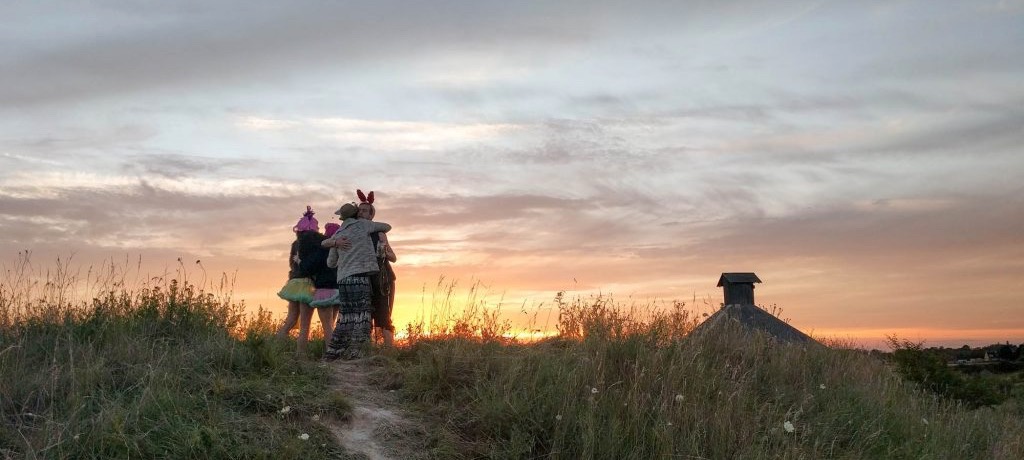 Connection itself remains the most mysterious yet obvious aspect of our shared world: what makes hearts
open or close, brighten or darken, strengthen or wither; how resonance and grounding and ego and love
actually move between conscious subjects, and within them. I've spent years circling the question,
slightly literally (Authentic Relating and Circling workshops, forty-plus regional burns, six
Borderlands and one Burning Man), continually perplexed and humbled by what I see, feel and still can't
quite name. There's an autistic systematiser's impulse in there too: the part that wants to map and name
what most people seem to navigate by feel. Vibe Science is what happens when I let that impulse build or
facilitate co-creation of something instead of just brood about it.
Connection itself remains the most mysterious yet obvious aspect of our shared world: what makes hearts
open or close, brighten or darken, strengthen or wither; how resonance and grounding and ego and love
actually move between conscious subjects, and within them. I've spent years circling the question,
slightly literally (Authentic Relating and Circling workshops, forty-plus regional burns, six
Borderlands and one Burning Man), continually perplexed and humbled by what I see, feel and still can't
quite name. There's an autistic systematiser's impulse in there too: the part that wants to map and name
what most people seem to navigate by feel. Vibe Science is what happens when I let that impulse build or
facilitate co-creation of something instead of just brood about it.
Underlying perplexity
Some of the harder version of this work pulls at me for the same reason: psychedelic theory, and the Qualia Research Institute's project (Andres Emilsson et al) of mapping the phenomenology of consciousness and the structure of valence. Both take the texture of first-person experience seriously as something the world has to reckon with rather than handwave past.There's growing reason to think this vision is closer than it sounds. Carhart-Harris's entropic-brain framework charts psychedelic states as measurable shifts in neural flexibility. QRI's Symmetry Theory of Valence proposes that pleasure and suffering track symmetry in the brain's harmonic dynamics, and the related work there maps altered-state phenomenology onto hyperbolic geometry. Connectome studies and altered-state fMRI are charting the texture of conscious experience with growing detail; clinical psychedelic trials at Imperial and Hopkins are turning previously-mystical experiences into measurable therapeutic outcomes. None of it dissolves the hard problem of consciousness, but together it shows that first-person texture is becoming approachable in ways that would have looked impossible a generation ago. If consciousness itself is slowly yielding to study, the felt-resonance between people might in time too.On the social-theory side the vocabulary already exists. Hartmut Rosa's Resonance (2016) is the closest thing to a rigorous philosophical name for what a good room between people actually is, and the four marks he uses to describe it (you are affected, you can respond, both sides are changed by the encounter, and the moment cannot be demanded, only invited) are unusually close to what the installations are trying to produce. Gregory Bateson, half a century earlier, had already insisted that the unit of mind is not the individual but the pattern that connects bodies and rooms and weather and history, an idea his daughter Nora carries forward today as symmathesy, the mutual learning that living systems do simply by being together. Vibe Science's claim that atmosphere is collective rather than individual is, philosophically, a Batesonian claim with a Rosa-shaped extension.
From sketch to forest
Vibe Science is one strand of a wider creative-engineering backlog I keep sketching: sleep-wellness contraptions, generative installations, oddly-specific gadgets that don't fit any existing genre. Among them is the Hyperbed, an Iron Man-style suspension orb I dreamed up while nearly immobilised by a leg muscle tear, when no position in bed was painless. The two Borderland prototypes are simply the first to make it out of the notebook.
The forest gong
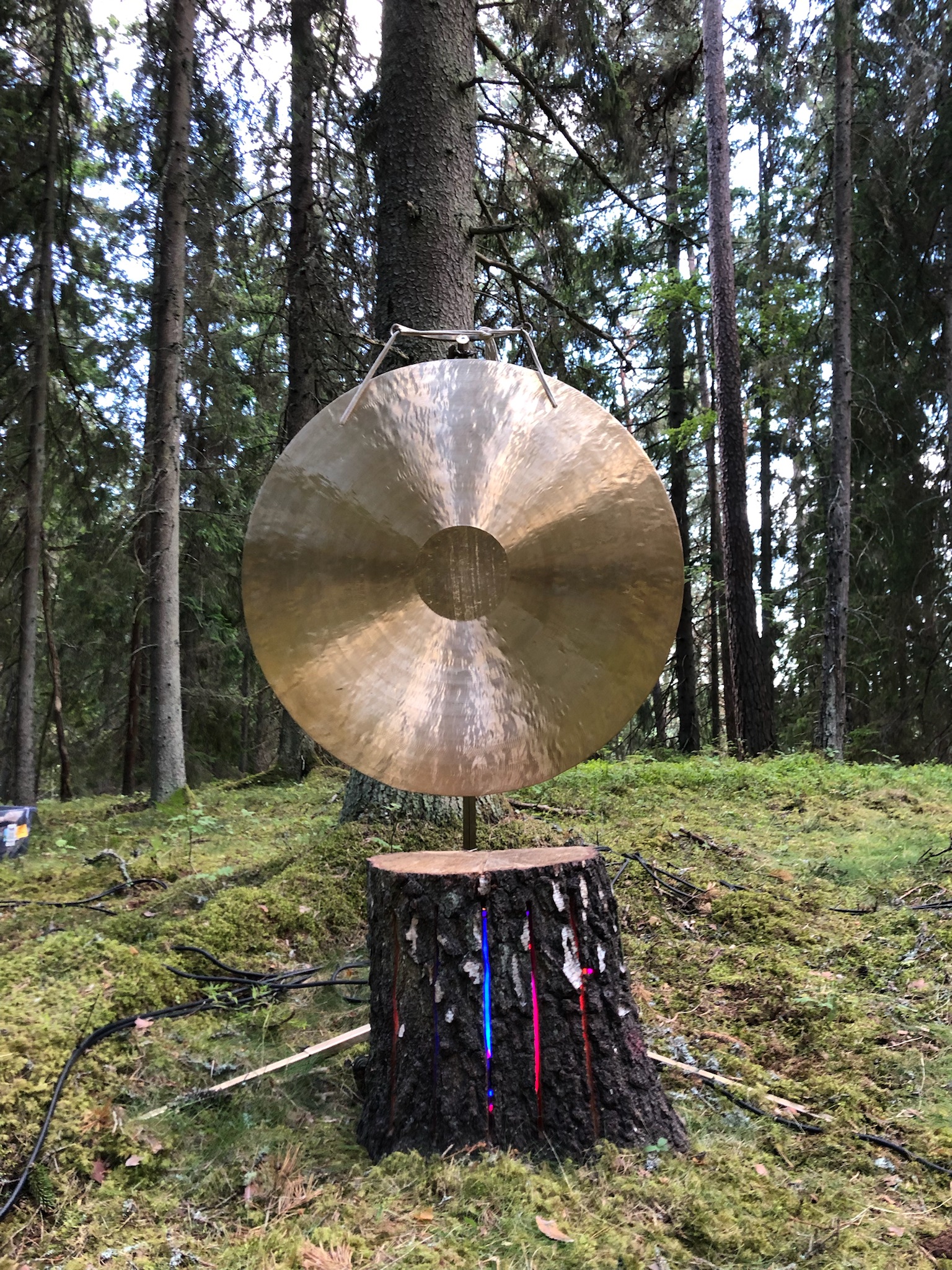 The forest gong turns sound into light. A microphone hidden inside a hollowed tree stump (an arborist
friend's chainsaw work, slits cut into the front) picks up the strike, and 150 metres of addressable LED
line woven through the trees pulses in synchrony. The audible vibration becomes a visible one, spreading
through the surrounding canopy. People show up, strike the gong without explanation, watch the trees
breathe in response. The mechanic is synchronisation, a strike that turns a gong bath into something you
also see, spreading through the trees around you.
The forest gong turns sound into light. A microphone hidden inside a hollowed tree stump (an arborist
friend's chainsaw work, slits cut into the front) picks up the strike, and 150 metres of addressable LED
line woven through the trees pulses in synchrony. The audible vibration becomes a visible one, spreading
through the surrounding canopy. People show up, strike the gong without explanation, watch the trees
breathe in response. The mechanic is synchronisation, a strike that turns a gong bath into something you
also see, spreading through the trees around you.
The soap-bubble portal
The soap-bubble portal is the more ambitious of the two. It's still mostly on paper, needing careful
engineering and a few collaborators to actually build. The image below is an AI rendering of what it
might look like in the forest a year or two from now, not a photograph.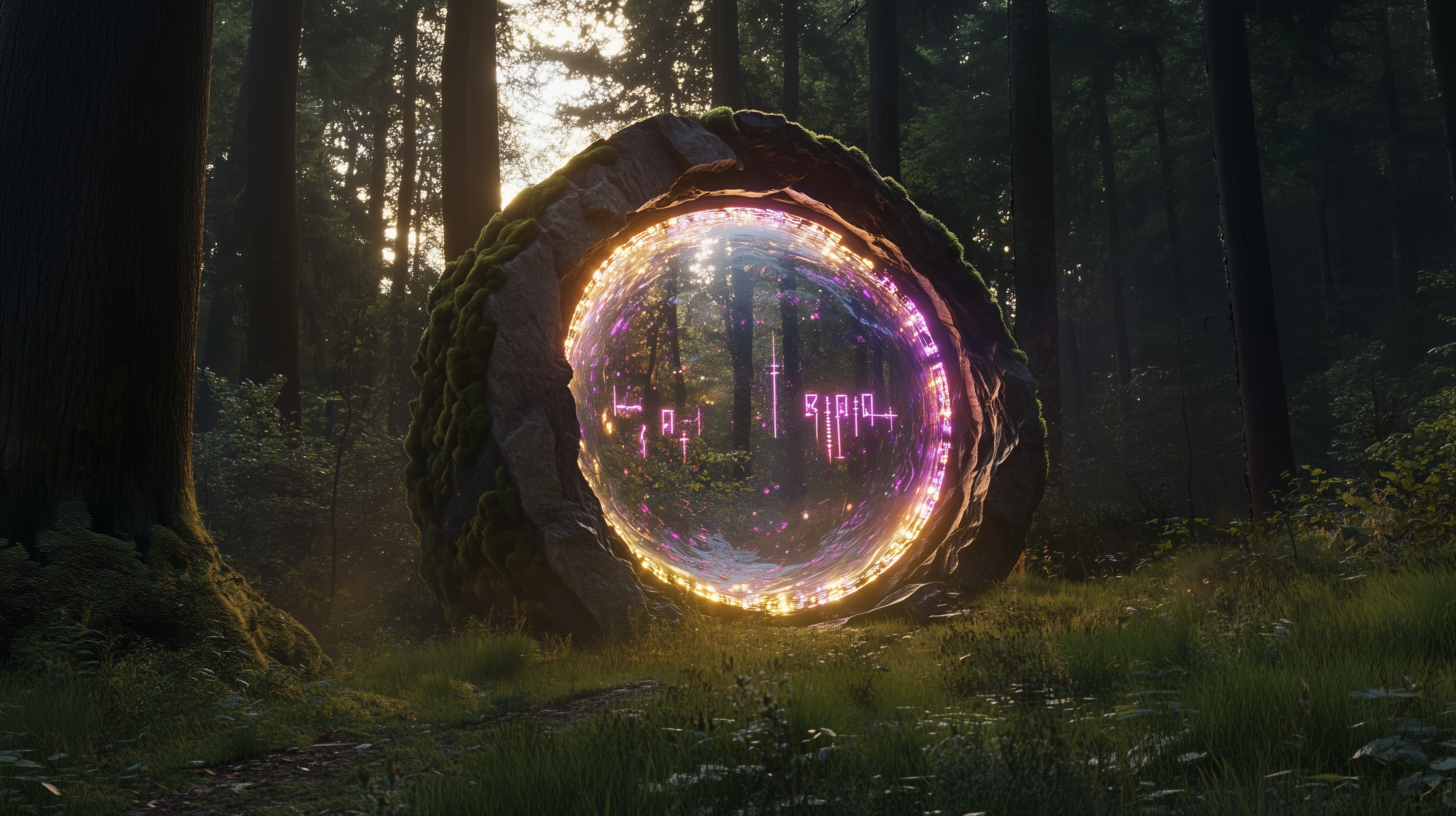 In concept, it sits in a forest glade: an apparently ancient stone ring roughly two metres across, with
glowing runes carved into the rim, sealed by a thick iridescent soap-film membrane stretched across the
opening. The look is somewhere near Tales from the Loop, old stone and synth tech. As you approach, the
runes wake. When you walk through, the membrane bursts in a synchronised flash of light and synth bloom.
Once you've crossed, a rotating frame quietly re-draws the film for the next traveller, and every
passage generates its own unique pattern of light and sound rather than replaying a canned loop. Sensors
detect the moment of crossing, a small generative engine seeds palette and rhythm anew each time, and
the LED-lit runes respond in synchrony around the rim.The mechanic is collective witnessing: a personal transition rendered visible to the group around it.
Doorways have measurable cognitive effects on attention and memory, and designing one with intentional
sound, light and shared attention makes the moment of crossing one you remember.Anthropologists have a name for the shape this takes: a rite of passage in Arnold van Gennep's sense,
with the group around the threshold doing what Victor Turner called communitas, the felt
togetherness that arises when people hold a transition for each other. The portal is a small designed
version of that shape.
In concept, it sits in a forest glade: an apparently ancient stone ring roughly two metres across, with
glowing runes carved into the rim, sealed by a thick iridescent soap-film membrane stretched across the
opening. The look is somewhere near Tales from the Loop, old stone and synth tech. As you approach, the
runes wake. When you walk through, the membrane bursts in a synchronised flash of light and synth bloom.
Once you've crossed, a rotating frame quietly re-draws the film for the next traveller, and every
passage generates its own unique pattern of light and sound rather than replaying a canned loop. Sensors
detect the moment of crossing, a small generative engine seeds palette and rhythm anew each time, and
the LED-lit runes respond in synchrony around the rim.The mechanic is collective witnessing: a personal transition rendered visible to the group around it.
Doorways have measurable cognitive effects on attention and memory, and designing one with intentional
sound, light and shared attention makes the moment of crossing one you remember.Anthropologists have a name for the shape this takes: a rite of passage in Arnold van Gennep's sense,
with the group around the threshold doing what Victor Turner called communitas, the felt
togetherness that arises when people hold a transition for each other. The portal is a small designed
version of that shape.
Toward a toolkit
The installations are the prototypes. The larger frame is UX for human relationships, and the longer-term ambition is to grow this into a small toolkit any group can reach for: protocols, environment design, and feedback instruments that nudge a room toward safer, braver, more creative states.
Keeping the rooms open
Acceleration is the slow undoer of the rooms we've built to find each other in. Attention fragments, what was warm grows cool, each of us becomes a little harder to find. The work isn't to engineer warmth back into being but to stay available for it: slower, more attendant, willing to be moved when the moment comes. Hearts open and close in the company of other hearts. Learning to keep ours open in this century, for each other, may be most of the work we have.The threads behind this →If you want the philosophical undercurrent of all this, the lineages and longer-form argument live on their own page.
Currently focused on
Deliberus
Deliberus →Collective-reasoning platform built on a knowledge-graph substrate, live at deliberus.com, in early hands with a small group of collaborators. Pursuing research grants in the AI-safety and collective-sensemaking space. The deeper bet: trust and non-zero-sum cooperation scale with the quality of the deliberation infrastructure underneath them, and that infrastructure has not yet been built.
Selective AI-orchestration consulting
AI →How I work →Consulting →Ideally 2–3 days a week, with engagements where there's a clear meaning-bridge to the work and values I'm building toward.
Ongoing open-source
Portfolio →A Graphiti fork (knowledge-graph memory for AI agents), nit and hemma (keeping several computers configured the same way), spela (one program that replaces a stack of media apps), and the surrounding tooling.Open to consulting commitments and, under the right conditions, employment too. What matters most is meaning-making and values alignment. I'm not the right person for casino apps or investment-banking optimisation, but very interested in work that helps people think more clearly, decide more wisely, or live more fully.
Deliberus
Deliberus is the project I have been carrying since 2009 and am finally building for real. The founding observation: individual minds, no matter how bright, are not up to the task of engaging with the full complexity of any wicked or polarizing issue alone. The key to advancing as a species is productively weaving our intellects together. The deeper move is not "I agree", but "I see your reasoning has integrity, even from inside a worldview I would not have chosen". That moment of attunement is the foundation of a kind of tolerance that ideology-matching cannot produce. In practice it is like putting on a pair of glasses with a tint and a refraction you have never looked through: the same world, bent through someone else's assumptions, and a position that looked arbitrary from outside lines up into something coherent. It is also the binding constraint on civilizational cooperation: not selfishness, but the cost of mutual understanding. Lower that cost and trust scales, non-zero-sum economics becomes thinkable, the deliberative substrate underneath every shared decision becomes inspectable.
The platform
The platform is the practical version of that dream. A reasoning substrate where any claim from any text or worldview can be decomposed into its premises, examined critically, and refined by anyone who cares to go deeper. Structure is output, never input, so the user simply talks while the system does the formal work underneath. What Wikipedia did for facts, Deliberus does for the way we think.
Where it is, who it's looking for
Live at deliberus.com, in early hands with a small group of collaborators, and applying through 2026 to research funders working at the AI-safety, deliberative-democracy, and collective-intelligence edge. Open to thinking partners, researchers, and funders who share that frame. Reach out if that's you.The threads behind this →The wider thinking Deliberus sits inside, including how it pairs with Vibe Science as halves of the same instinct, lives on its own page.More: vision · where our thinking is right now
Consulting
My consulting rate is currently around 1,600 SEK per hour, with some flexibility depending on complexity and duration of the project. I lean toward longer engagements where I can build context and ship things end-to-end, with a deliberate eye on sustainable workload. Book a discovery call (currently free) to explore how I can help.How I work with AI agents →Most of what I take on today is done together with AI agents, with me deciding the architecture and keeping the quality; how that works in practice is on its own page.Curious also about work with AI safety organisations or other purpose-driven non-profits. Happy to discuss sliding scale for mission-aligned work.Open to consulting commitments and, under the right conditions, employment too. What matters most is meaning-making and values alignment. I'm not the right person for casino apps or investment-banking optimisation, but very interested in work that helps people think more clearly, decide more wisely, or live more fully.
The threads behind the work
Pulled out here because the same threads run through more than one project at once, and on any single project page they crowd the prose. Read this if you want the philosophical undercurrent; ignore it if you came for the work itself.A handful of lineages shape the way I think about all of this, and I want to name them, even when the books behind them are heavier than the projects suggest.The social-resonance thread is the strongest. Hartmut Rosa's Resonance (2016) and the Batesons (Gregory's "pattern that connects" and Nora's symmathesy) both push the same point against modern individualism: the felt thing between people is not in your head; it is between heads. Most of the projects on this site rest on some version of this claim.Sitting next to it is an attention-and-meaning thread. Iain McGilchrist's case for the right hemisphere is, in everyday terms, a case for the kind of attention that meets the world as living and related rather than grasping it as a set of parts. John Vervaeke names the same territory from another angle: participatory knowing, the knowing that happens by taking part, and religio, the re-binding of attention that ritual and shared rhythm produce in a group.A cybernetic thread answers a different question: how do groups stay viable, and how do small feedback signals shape what a system becomes? Stafford Beer's Viable System Model is the rigorous version of the intuition that a room could have a thermostat for its own state. Daniel Schmachtenberger's work on the metacrisis is one zoom level further out, asking what kind of collective sensemaking a civilisation that wants to last actually needs.Anthropology gives the last named shape: Arnold van Gennep's rites of passage and Victor Turner's communitas describe what a designed threshold is trying to be, and why the people gathered around it matter as much as the threshold itself.And then the deepest commitment, the one that ties all of this together for me. I feel that humanity's future deeply depends on us understanding, and then more skilfully inhabiting, the cognitive niche our species actually evolved into: fluid, generalist, deeply social, more dependent on shared attention and shared meaning than any other animal we know of.Most animals that thrive have one thing they're very good at: the cheetah's speed, the bat's echolocation, the anteater's tongue. Our adaptation is the inverse. We got good at not being good at any one thing, and that broad-minded tinkering is the actual species-level skill: we're the analogisers, the bridge-builders between fields, the figurers-out of new niches on the fly. The same case is made at the individual scale by David Epstein in Range: in complex domains, breadth tends to beat narrow expertise, because the analogical reasoning generalists do is what creative problem-solving actually is.And the same broad mode keeps building the structures above us: cooperating groups, durable institutions, civilisations that hold many kinds of mind together. That capacity is what has let us spread into every corner of the biosphere and bend it to our needs, for better and for worse.David Deutsch sharpens what "bend it to our needs" actually means. He reframes wealth as the repertoire of physical transformations a person or species can cause, which makes the cognitive niche above the substrate for what he calls universal explanation: every transformation not forbidden by the laws of physics is, given enough knowledge, in principle available to us. That same framing is why the qualifier in the line above earns its place: the knowledge that lets us bend the world is the same knowledge that lets us bend it badly, and what distinguishes the two is whether the civilisation doing the bending is willing to keep criticising itself. His own evaluative criterion, that a good explanation is one hard to vary while still solving the same problem, is one I think both Vibe Science and Deliberus could be measured against.Vibe Science →Deliberus →The two projects on this site where this thinking shows up most directly are Vibe Science and Deliberus, and they're complementary halves of the same instinct. Vibe Science is about the felt encounter between people, what makes hearts open or close. Deliberus is about weaving our minds together, with structured intersubjective scrutiny of all claims, so we can align human with human and human with machine. I think we need both.
How I work with AI agents
Today the agents write most of the code. I make the decisions on architecture, algorithms and logic, I know a lot about the quirks and features of the languages and frameworks I use and have opinions on them, and I'm meticulous about the quality of the code, design and UX that come out of it.
Since July 2023
My first commits together with an AI agent are from 15 July 2023, in a public fork of LEDfx where I used Aider with GPT-4 to make audio-reactive light effects for a wind gong at Borderland. I was pretty much in love with it from the start, hallucinations and all. A month later I started a group chat with some friends exploring the same thing, Anton Osika among them, who was building gpt-engineer at the time (it later became Lovable). We compared tools and I wrote a script that turned the source of a project's dependencies into embeddings, so an agent could look up how a library really works.
The Cursor years
I installed Cursor in the autumn of 2023 and from late 2024 it was my main tool, for ArtoMatic and the first months of the document-processing platform among other things. I often had several models in the same chat, Gemini for the overview, o3 for tricky bugs and Claude for the edits. As the projects grew so did the problems, the agent forgot whatever wasn't in its rules files and the bill went over the plan more than once.In the summer of 2025 I spent about seven weeks on AgentLoom, a prototype for keeping an eye on several coding agents at once, each in its own copy of the repo and its own editor window. An agent that was unsure would ask me something on a small card on the screen, with a couple of buttons to answer. I built the backend and the overlay and then dropped it, since controlling an editor from the outside turned out too fragile, but answering agents through small cards, also from my phone, is something I'm still building towards.
A messy switch
That summer new tools came out every week, Windsurf, Kiro, Warp, Claude Code, and I lost about a week on a detour into Warp. By the end of July I felt cognitively overwhelmed by the choice itself. On 1 August 2025 I decided to make Claude Code my foundation and stay with it for a while, mainly since it could be extended in all the ways I needed. The hardest thing to give up was asking several models, until I could keep doing that through a tool inside Claude Code. The switch was cumbersome and there was a lot to rebuild, but once I stopped revisiting the decision things fell into place.
How it looks now
I usually have several Claude Code sessions going in parallel, one per project, at the desk or from my phone through Remote Control, so I can come and go and continue hours later. For anything larger I write the spec with the agent first and question it until the implementation feels obvious. Small hooks remind the agents of my rules right when they matter, and most of those rules exist because an agent once got something wrong in a way I don't want repeated. The agents can search my documents, code and earlier decisions through mannaminne, so they find what's already been tried. Ruby, my voice assistant, narrates the few things worth hearing from the sessions in the background, and on harder decisions I sometimes ask GPT and Gemini for a second opinion. Many prompts start as dictation or as one of the shortcuts on my Caps Lock key.
What I'm careful about
An agent's explanation of why something works is a guess until a test or an actual run shows it, so I ask for the run. I also keep the documentation true as the work changes, since the next session, human or agent, will believe whatever it says.AI →Consulting →If you want help setting up agents that keep their quality over months, the Consulting section says how I take on work.